Showing posts with label Anegada Passage. Show all posts

Saturday, February 15, 2014

The “Oh-my-god-a Passage”

St. Martin to the Virgin Islands

The stretch of open water between St. Martin and the British Virgin Islands (BVIs) is marked on some charts as the Sombrero Passage and as the Anegada Passage on others.  Many sailors refer to it as the “Oh-my-god-a Passage.”  The passage has very deep water between the shallow water surrounding the Virgin Islands and St. Martin.  The fast moving current in the passage has a tendency to make the seas “lump up a bit” as it encounters the shallow areas.

 Simpson Bay Bridge

Standard procedure is to exit the St. Martin Lagoon at the 4:00 PM bridge opening, wave good bye to friends on the deck of the Sint Maarten Yacht Club, and anchor outside in Simpson Bay.  The next outbound bridge opening is not until 8:30 AM. 

Sint Maarten Yacht Club

It takes Motivator 10 to 10 ½ hours to do the 81 NM to the BVIs.  The prudent mariner does not run the chance of being forced to enter an unfamiliar harbor after sunset.  So, an early departure (6:00 AM) is warranted.
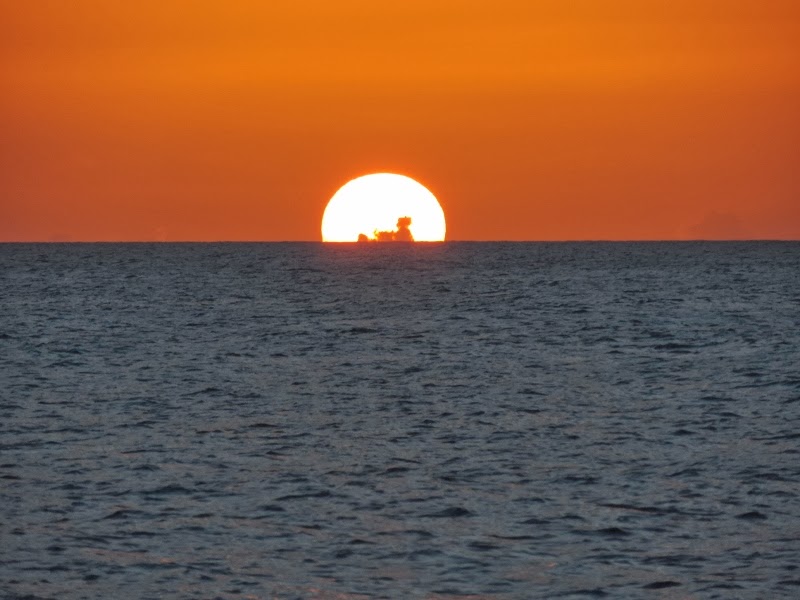

Besides, it gives you a chance to enjoy another spectacular Caribbean sunset.

Friends we met on the way to the BVIs

We waited 3 weeks for a good weather window to make the passage, and our patience paid off.  The wind for most of the way was less than 15 knots and we had a gentle following sea with only the occasional large swell.

Riding our bow wake

The two pods of dolphins we encountered each had 7 to 8 healthy looking members of various sizes.  One pod had distinctive stripes while the other had freckles.  Each pod stayed with us for about 10 to 15 minutes.  Pollie thinks they liked us because she was on the bow waving and talking to them.  I think it was the Dire Straits album I was playing.

Motivator in Biras Creek, BVIs

While we enjoyed our time in Sint Maarten, we were ready for the quiet of Biras Creek.

Saturday, May 11, 2013

Plugging Leaks & Catching Fish


A fellow boater once told me, “all boats are sinking; it’s just a matter of time.”  But, this article is not about water leaks.  Someone with firsthand experience can write that article. 


This article is about electrical leaks.  When a boat is “leaking” electricity it has to go somewhere.  Usually it is into the water through underwater metal components such as the propeller shaft and propeller.  Besides destroying metal components and eating up zincs, a leaking boat can repel fish.  If you are not catching fish, it may because your boat is leaking electricity, but more on that later. 


Upon arrival at Marina Bas-du-Fort, on the south end of the French island of Guadeloupe in the West Indies, we plugged in to a 220 volt, 50 amp outlet and promptly blew the circuit breaker on the power pole.  French islands use European standards which include very sensitive Ground Fault Circuit Interrupt (GFCI) circuit breakers.


An electrician had me turn all the boat’s breakers off, reset the GFCI breaker at the power pole, and then he watched as I individually turned the equipment back on.  It turned out that we had two offenders, the inverter/charger and the oven.  The First Mate’s solution for the oven was that we could eat out. 

 Pollie’s Valentine Gift
(she was so happy)

The inverter/charger was replaced, and that cured the problem.  The breaker at the pole quit having a hissy fit when we plugged in.  But, that got me thinking; does Motivator have other electrical leaks?


Without the advantage of a finicky French marina, checking for alternating current (AC) leaks can be done with a clamp-on amp meter clamped around your shore power cord.  The current flow is really in two directions, it is alternating.  It must cancel itself out, or be a sum zero situation.  So if your boat is not leaking the amp meter should read close to zero.  One amp is way too much and could fry a nearby swimmer.


A check should also be made for Direct Current (DC) leaks and stray current in general to ensure your boat is not driving fish away and eating zincs.  This is best performed away from the dock so that you are not reading your neighbors leakage.  A silver chloride electrode available from BoatZincs.com (no affiliation with Motivator) that plugs into your multimeter for ease of taking readings is just the ticket.  Again, do as the electrician in Guadeloupe taught me, turn off all components and then turn them on one at a time to find the culprit.

Small but tasty tuna

Success!  Once the electrical leaks were plugged, our previously dismal fishing performance ended and we started catching fish.  The first was this Black Fin Tuna caught leaving Guadeloupe.

Barracuda caught and released off Culebra

I know what you are thinking - coincidence.  Scientific research has proven that fish are both attracted and/or repelled by electricity.  Commercial fishermen have effectively used electricity to help herd menhaden and shrimp into purse seines.  There are even electric lures available see: www.magnabait.net (not a recommendation, merely an example). 


This 4’ 4” Bull Maui Maui was caught in the Anegada Passage.  Coincidence?  Motivator had suffered a long drought, but now her freezer is full of fish.


This guy had to be filleted on deck then released because it was too big for my cooler and cleaning table.

Special Note:  The First Mate managed to gaff this 25 to 30 pound angry Maui Maui and fling it into the cockpit in one fluid motion.  Then she held it down and applied “fish killer” (cheap Vodka) to its gills.  The whole time she was apologizing to the fish.  Very impressive!